Textile Craft & Everyday Use
Coyuchi Bedding: How Fiber, Weave, and Finish Shape Comfort
A bed linen’s character is not a single quality stamped onto a label. It emerges from a sequence of decisions: what plant supplied the fiber, how that fiber became yarn, how the yarns were woven, and what happened to the cloth afterward. Looking closely at those decisions makes it easier to understand why two pieces of linen can feel so different—and why the word “luxury,” by itself, explains very little.
Bedding is encountered at close range, in the dim light before sleep and in the brighter, less forgiving light of morning. A sheet wrinkles, a duvet cover shifts, a pillowcase takes the impression of a face. These ordinary events are part of the textile’s performance. They also complicate the polished language often used to describe premium bed linen. Softness, breathability, durability, and drape are not independent virtues, and none is guaranteed by an elevated price or a pleasing color name.
Coyuchi bedding offers a useful point of departure for considering those questions, particularly where organic linen is concerned. A product description can disclose a great deal—fiber source, place of weaving, certification, weight, construction, care instructions—but the details matter most when read together. “Organic,” for instance, concerns how fiber is grown and processed under a particular standard; it does not automatically tell you whether a fabric will feel crisp or yielding. “Relaxed” may suggest a finished texture, but the word has no precise universal meaning. To understand the object, one has to move from the attractive adjective to the material facts beneath it.
This is not an exercise in turning the bed into a laboratory. It is a way of paying better attention. A sheet is a small piece of industrial history made intimate: agricultural work, spinning, weaving, finishing, sewing, and household care gathered into something that is expected to disappear beneath us. Fiber, weave, and finish are the parts of that history most likely to be visible in a product specification—and most useful when comparing linen bedding.
Begin with the fiber, not the adjective
Linen begins with flax. The long, slender fibers are extracted from the plant’s stem and prepared for spinning. Their natural structure gives linen a distinctive character: it can feel dry and textured against the hand, yet it is also capable of becoming more supple with use. Compared with cotton, linen often has a more pronounced irregularity. Fine variations in yarn thickness and the small slubs that may appear in the cloth are not necessarily defects. They can be part of the material’s visual and tactile vocabulary.
That vocabulary is not fixed. Fiber quality, yarn preparation, spinning, and weaving all influence the result. A fabric made with finer, more uniform yarns may feel smoother and appear more even; a more visibly textured cloth can feel substantial or pleasantly informal. Neither quality is inherently superior. The question is whether the fabric’s character suits the person using it, the climate of the bedroom, and the way the bed is maintained.
Product descriptions for Coyuchi’s organic linen commonly identify flax grown in France and linen woven in Portugal. The distinction is worth noticing. The location where flax is grown is not necessarily the location where it is spun or woven, and “French linen” can refer to the origin of the flax rather than every stage of manufacture. A transparent account of origin helps readers follow the material’s journey without collapsing cultivation, processing, and production into one vague claim.
Organic status is another specific, and useful, piece of information. The organic linen duvet cover discussed here is described as GOTS certified, with flax grown in France and the linen woven in Portugal. Certification can offer a framework for evaluating organic fiber sourcing and aspects of processing, but it is not a substitute for reading the rest of the specification. It does not, on its own, tell you the fabric’s weight, the exact hand it will have, how it is finished, or whether its construction suits your bed.
Weave gives the yarns their meeting place
Once yarn has been made, weaving determines how it is arranged. In a woven fabric, lengthwise warp yarns meet crosswise weft yarns according to a chosen pattern. The simplest familiar structure, plain weave, alternates the yarns in a regular over-and-under sequence. Other structures produce different surfaces, degrees of drape, and patterns of light. The precise consequences depend on yarn, density, and finishing as well as the weave itself; the name of a weave cannot carry the whole explanation.
Linen bedding is often described as breathable. That quality is associated with the fiber and with the way the fabric is constructed, but it should not be treated as a promise that every linen sheet will feel identical. A looser construction may feel airier and less compact. A denser cloth may feel weightier and more substantial. The balance is affected by yarn size, fabric weight, and the arrangement of yarns, among other factors. When a listing provides a weight—often given in grams per square metre, or gsm—it offers one useful point of comparison, though not a verdict on comfort.
The word “weave” is sometimes used casually to mean the whole character of a fabric. In practice, it is one part of a larger system. A crisp hand may have more to do with yarn and finish than with a simple weave label. A linen that drapes loosely may owe that movement to its construction and washing history. When specifications are spare, a reader can still make a sensible comparison by looking for the composition, weight where available, origin, construction details, and care directions together.
There is a useful restraint in this approach: it avoids pretending that a specification can reproduce the experience of touching cloth. Two fabrics with similar descriptions may still differ in hand. But the details can narrow the field. They help explain the likely character of a piece and give the consumer a better question to ask: not “Is this the best linen?” but “What kind of linen is this, and is that the kind I want to live with?”
Finishing is the part that meets the hand
Finishing comes after the cloth has been made and can substantially alter its surface and behavior. Washing, garment treatment, softening, and other processes may reduce a newly woven fabric’s stiffness, change its drape, or create a more lived-in appearance. The details vary by product. A stone-washed linen, for example, is described as having undergone a process intended to give it a softer, more relaxed feel. A plant-based softener is a different kind of finishing detail, and the phrase should be understood as a description of the treatment rather than a complete account of every manufacturing step.
In the Coyuchi organic relaxed linen bedding descriptions, the relaxed quality is paired with the claim that the fabric softens through use. Some listings also identify a plant-based softener finish. These are practical clues: the bedding is presented as having a less formal, more yielding character than a cloth that is sold chiefly for crispness. Yet “softens with every wash” is still a general description, not a measurement. Individual impressions vary, and laundering choices influence the way linen changes over time.
Finishing helps explain why a new linen duvet cover may not feel like an old one. The older piece has been washed, dried, folded, slept under, and perhaps repaired. Its softness is not simply an attribute bestowed at the factory; it is also the record of repeated use. This gradual change is part of linen’s appeal for many people. It can make the bed feel less like a staged room and more like a room inhabited by someone who has found the right pillow and intends to stay there.
Some finishing details also concern color. Dyes and washing can shape the way a surface looks, and subtle variations may be more evident in textured fabrics than in smooth, uniform ones. For anyone comparing colors online, it is sensible to remember that screen display, room light, and neighboring textiles all affect perception. A warm white beside a natural flax shade may look different from the same white seen alone. That is a fact of viewing, not a shortcoming unique to linen.
Construction details are small forms of engineering
A duvet cover must do more than look agreeable at the foot of the bed. It has to hold an insert, stay closed, and tolerate regular laundering. Details such as an interior flap, buttons, and ties are therefore not merely decorative. They shape the day-to-day relationship between the cover and the duvet inside it.
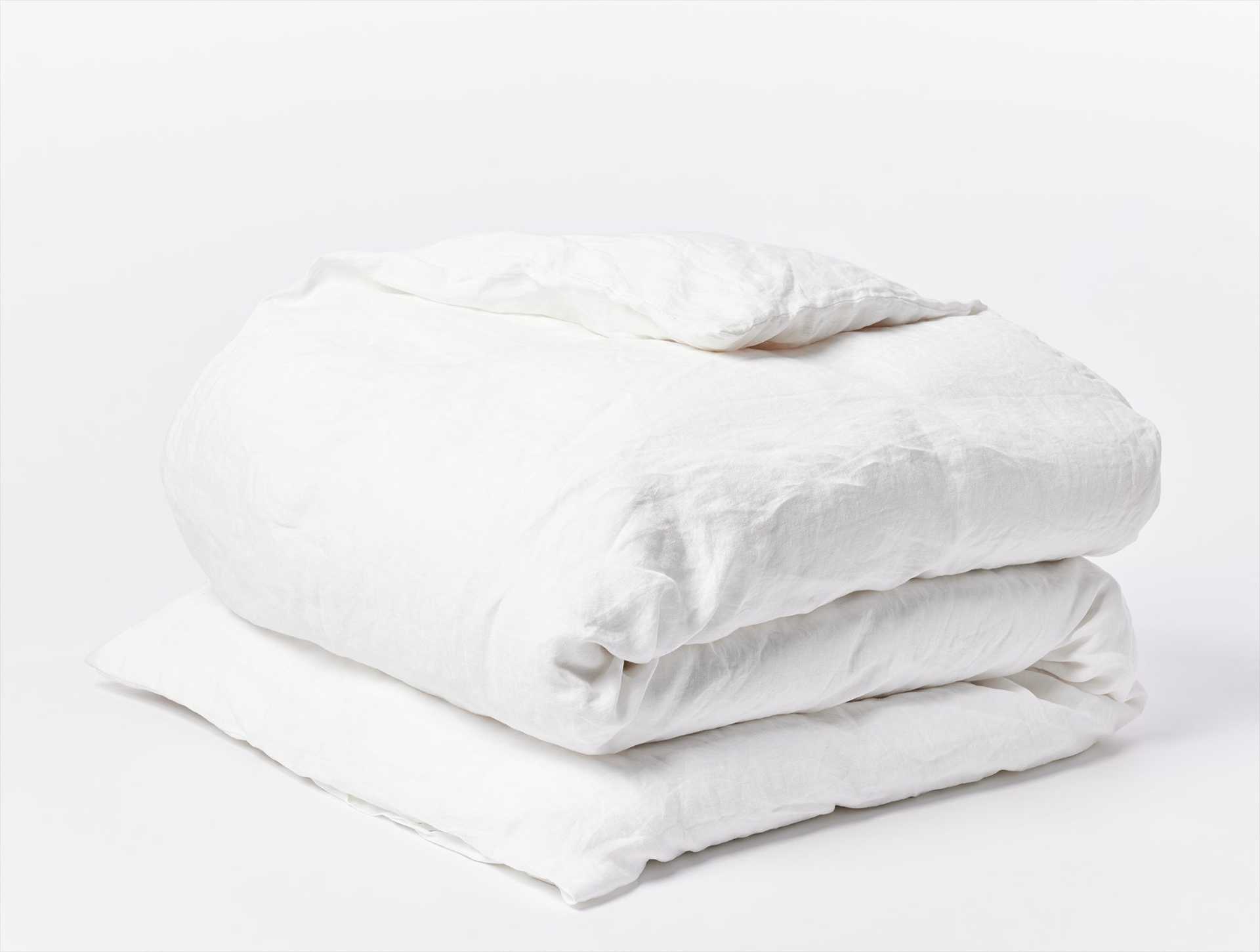
The Coyuchi Organic Relaxed Linen Duvet Cover is described as made from GOTS-certified organic French linen, woven in Portugal from flax grown in France. Its listed construction includes an eight-inch interior flap, coconut shell buttons, and inside ties intended to help keep the duvet in place. These details do not tell us everything about the quality of the stitching or the experience of changing the bed, but they make the intended design legible. The cover is built to enclose the insert rather than simply lie over it.
The same attention applies to sheets. A fitted sheet’s pocket depth and elastic construction affect whether it stays secured to a mattress. The available Coyuchi relaxed linen sheet descriptions identify a fitted sheet with full elastic and a pocket depth of around fifteen inches in certain sets. Those measurements are useful only when compared with the actual mattress, including any topper. A beautiful sheet that repeatedly lifts at the corners has failed an elementary test of domestic design.
Finishing details such as pick-stitched cuffs also deserve a measured reading. They may lend a subtle tailored edge to a pillowcase or sheet, but they are not evidence by themselves of exceptional durability. The more practical questions are how the seams are assembled, whether the item fits the intended bed, what the washing instructions require, and whether the finish will remain pleasing through ordinary use.
Comfort is a relationship, not a slogan
Linen is frequently associated with temperature regulation, breathability, and moisture management. These descriptions point to properties that can make linen attractive in bedding, especially for people who dislike a dense or clammy-feeling surface. Still, comfort is personal and contingent. Room temperature, duvet fill, mattress materials, sleepwear, and individual preference all contribute. The same linen can feel cool to one sleeper and substantial to another.
There is also a difference between a fabric’s capacity to manage moisture and a guarantee of a particular night’s sleep. Textile language sometimes leaps from material properties to sweeping health claims. A careful reader should keep the distinction clear. Linen may have features that make it appealing for a breathable bed environment; that is not the same as a promise to cure allergies, prevent overheating for every person, or improve sleep in a measurable way.
A useful comparison begins with the desired feel. Someone drawn to an easy, textured, slightly rumpled bed may prefer relaxed linen. Someone who wants a smooth and formally pressed surface might choose a different fabric or construction. The sensory question can be difficult to answer without handling the cloth, so return policies, fabric samples when available, and clear descriptions become meaningful parts of the decision—not afterthoughts.
Climate matters, but not in the simplistic sense that one fabric belongs to summer and another to winter. Linen’s texture and ability to work as a layer can make it suitable across seasons, while warmth depends heavily on the duvet, room, and number of layers. A cover is one element in a larger sleep system. It is rarely the sole author of comfort.
Care is part of the fabric’s future
Care instructions are often relegated to the end of a product page, where they appear as an administrative nuisance. They are better read as part of the material’s design. A fabric intended for gentle washing at a low temperature asks for a different household routine from one that tolerates more vigorous treatment. Following the manufacturer’s guidance reduces avoidable wear and gives the textile a better chance of retaining its character.
For the Organic Relaxed Linen Duvet Cover, the listed guidance is to machine wash cold on a gentle cycle, tumble dry on low, and remove promptly; warm ironing is optional. This is practical information, not a ritual. A gentle cycle limits unnecessary agitation, and avoiding excessive heat may help prevent the sort of rough treatment that shortens a textile’s useful life. If the care label on the actual item differs from a product description, the item’s own label should take precedence.
Detergent choice and load size also matter. Overfilling a washer can keep bulky bedding from moving freely, while harsh or unsuitable products may affect color and hand. Linen’s wrinkles are often treated as a design feature, but “wrinkle resistant” is not the same as wrinkle free; the distinction is worth accepting before the first wash. The relaxed appearance is part of the fabric’s visual language, not a maintenance failure that must be corrected with an iron.
Long use can be a meaningful part of a textile’s sustainability story, though no one attribute settles the larger question of environmental impact. Organic certification, fiber origin, manufacturing stages, durability, and the way an item is cared for all contribute to a broader assessment. A product described as durable is not immortal. It still benefits from sensible use, careful washing, and repair when repair is possible.
How to read a bedding description with care
Product copy is designed to be inviting. That is understandable: bedding is bought partly for an imagined experience, a bedroom in which the light is softer and the day is finished. But useful comparison begins when atmosphere gives way to specifics. A reader considering premium linen can move through a short sequence of questions.
- What is the fiber? Look for an explicit composition, such as 100% linen, rather than relying on a collection name.
- What does the origin statement describe? Separate the source of the flax from the place where the linen was woven or the finished bedding was made.
- Is a certification identified? Note what the named certification covers, and do not assume it answers unrelated questions about hand, comfort, or construction.
- What is known about the cloth? Weight, weave, washing, and finishing details can help explain whether it may feel light, substantial, crisp, or relaxed.
- How is the item assembled? Closures, ties, pocket depth, elastic, and seam details are part of everyday performance.
- What care does it require? Instructions should suit the household as well as the fabric.
These questions are not a checklist for finding an imaginary perfect sheet. They are a way to recognize trade-offs. A finer, smoother surface may feel different from a weightier, visibly textured one. A fabric that arrives soft may have been treated to feel that way; another may change more noticeably with laundering. Neither sequence is necessarily the right one. The best comparison is the one that makes the expected experience clear enough to choose deliberately.
The quiet intelligence of a well-made bed
“Luxury” can suggest rarity, expense, or a certain polished look. In textiles, it may also point toward more tangible qualities: a carefully selected fiber, competent weaving, thoughtful finishing, sound construction, and a surface that becomes agreeable through use. Those qualities do not always arrive together, and they do not erase the importance of personal preference. A luxurious object that is difficult to care for or uncomfortable to sleep under may be luxurious chiefly in theory.
Looking at Coyuchi bedding through fiber, weave, and finish gives the term a more useful scale. The organic French flax and Portuguese weaving described for the relaxed linen duvet cover provide a traceable material story. Its GOTS certification offers a defined reference point for organic sourcing and processing. Its relaxed finish, coconut shell buttons, inside ties, and interior flap indicate how the makers have considered both surface and use. None of these facts is a complete account of the bedding, but together they are more illuminating than a general claim of softness or sophistication.
Eventually, of course, the bed has to be slept in. A person notices whether the cover shifts, whether the cloth feels pleasing against the skin, whether the morning light catches its texture, and whether washing it fits easily into the week. The point of textile knowledge is not to replace that judgment but to sharpen it. A product description becomes more than a page of persuasive language when it helps connect the field where flax grows to the cover folded back at bedtime.
In that sense, comfort is not hidden somewhere inside the word “linen.” It is made, one decision at a time: fiber chosen, yarn spun, cloth woven, surface finished, seams assembled, fabric washed, bed made. The qualities that matter most are the ones that survive contact with ordinary life. That is where a well-considered piece of bed linen earns its place—not in the adjective attached to it, but in the way it feels after the room has gone quiet.